Six of Seven Gardening Mistakes - Rotate Crops

My new Bluebird Gardens strawberry bed refreshed with compost and new plants.

My new Bluebird Gardens strawberry bed refreshed with compost and new plants.

Lost any strawberry beds? I did last winter, and it was a mild one. My best guess is that the soil was tired and could not support the plants, which are heavy feeders.

Why Rotate Crops?

Rotating crops breaks lifecycles. Many fungal blights, rusts and spots are host specific. Their spores remain in the soil and affect the next batch of plants. Most caterpillars, beetles and borers and some nematodes also show a definite preference for certain plants or plant groups. Their eggs and larvae are in the soil awaiting their host plants.

Rotate Every Third Year

Another reason why crop rotation is important is that different plants have different nutritional requirements. A simple rule of thumb is plant the same crop only two years in a row.

Last but not least, one of the biggest mistakes home gardeners make in their gardens.

Charlotte


Five of Seven Gardening Mistakes - Compatible Plants

Yellow onion sets planted next to roses help keep my Bluebird Gardens roses bug-free.

Yellow onion sets planted next to roses help keep my Bluebird Gardens roses bug-free.

In this seven-part series, I am going over the biggest mistakes I see gardeners make and how to address them. I have made far more mistakes but these are the main ones I see repeated in questions readers of my weekly gardening column "Gardening to Distraction" email or call me about.

Plants That Get Along

This one is not so much a mistake as a missed opportunity for natural pest control and bigger yields. It's called "Companion Planting."

According to Amazon's book description: "Plant parsley and asparagus together and you'll have more of each, but keep broccoli and tomato plants far apart if you want them to thrive. This classic companion-gardening guide outlines the keys to creating a harmoniously varied and bountiful garden. Utilize the natural properties of plants to nourish the soil, repel pests, and secure a greater harvest. With plenty of insightful advice and suggestions for planting schemes, Louise Riotte will inspire you to turn your garden into a naturally nurturing ecosystem."

Three Sisters

The "three sisters" planting concept is the same thing, some plants are more compatible than others. I plant onions around my roses to keep bugs off the roses and to more easily find onions when I need them. I guess I could also eat my roses but I prefer them in flower vases!

Charlotte


Four of Seven Gardening Mistakes, Plant Bare Root Plants

Rooted elderberry starts getting potted before being planted straight into the ground.

Rooted elderberry starts getting potted before being planted straight into the ground.

There are many gardening mistakes; I have made most, if not all, of them. When I dream about my garden, I don't necessarily think about these mistakes but they do determine whether my garden turns out the way I imagined it. In this series, I am highlighting the seven gardening mistakes I hear from friends and readers of my weekly gardening column "Gardening to Distraction."

Planting Bare Roots Requires Perfecting Planting Conditions

We have all done it, ordered bare root plants and stuck them immediately in the garden. It can work if the conditions are just right; soil is moist, roots have been hydrated, temperatures are warm and these conditions continue for several weeks until the roots establish themselves. 

Most of the time, however, those perfect conditions are not available for the needed length of time.

Plant Bare Roots First in Pots

To make sure bare root plants get a good start, plant them in potting soil in pots. You can recycle pots after washing, or make pots out of common household items that are clean.

Make sure they get regular watering and are growing in conditions that will help them succeed, such as protection from wind and hot sun. Even sunny plant seedlings need a little cover until they get used to the conditions.

It does take a little more time but it's well worth the effort.

Charlotte
 

Third of Seven Gardening Mistakes - Plants In Right Place

Wild columbine has a tendency to grow in places where it can easily be damaged.

Wild columbine has a tendency to grow in places where it can easily be damaged.

There are a number of mistakes we as gardeners make, sometimes not knowing it's bad. Then there are those mistakes that take a little change of habit to have better results. Understanding the size of the plant when it grows to maturity is one of those.

Know Mature Plant Size

When we buy plants, they tend to be small or smallish. It's easy to think that's the final size of the plant unless one looks at the tag or, better yet, researches the plant characteristics. One of the best places to get information about Missouri plants, including wildflowers, is the online library at Missouri Botanical Garden: mobot.org.

In the meantime, when buying plants look at the enclosed tag and place the plant in your garden where the size will fit.

Think Through Best Place

Now I have a tendency of planting vertically. By that I mean I plan plants on top of bulbs so that once the bulbs die off, the perennial takes over for the rest of the season. Sometimes, however, the plants are too big for the space so I have to make a note and carefully dig it up to place it in a better location. Every time a plant is moved, the trauma can damage it so try to minimize any unnecessary garden travel.

A little advanced planning, and reading, will help you settle the right plant in the correct space.

Four more gardening mistakes to cover, can you guess what they are?

Charlotte
Second of Seven Gardening Mistakes - How to Water

A two-gallon watering can and $20 watering wand are essential garden watering tools.

A two-gallon watering can and $20 watering wand are essential garden watering tools.

We all make them, or develop them. Habits that stand in the way of being successful gardening. This is the second of seven gardening mistakes I certainly have made and share to remind both of us to stay away from perpetuating them.

Forgetting to Water or Shallow Watering

Either one of these are guaranteed to kill off plants. Soil needs water to keep resident bacteria and microorganisms alive and healthy. That miniscule ecosystem is what feeds plant roots so without water, the ecosystem dies and there are no nutrients to feed plant roots.

Although I have killed off my fair share of plants by forgetting to water, I now water as I plant. I carry a watering can whenever I am planting so I don’t forget or get distracted and then forget to go back.

Deep Watering Better Than Sprinklers

It is also better to water deeply with an in-ground watering wand than a sprinkler, especially when temperatures are 100F and higher. The tops of plants may die off in those temperatures but if watered, roots will survive and come back next year.

I watched a lady sitting next to her above ground sprinkler last summer. The water evaporated by the time it reached the highest point in the arch so it wasn't doing anything but giving her a cool mist. Maybe that's what she wanted but it wasn't helping her plants.

Invest in a watering wand and water deeply. They run about $20 and are the best investment in terms of water management. Not only will you have to water less frequently but your plants will have a higher survival rate.

Next, a basic practice critical to successful gardening. Do you have a favorite?

Charlotte
 

First of Seven Gardening Mistakes - Good Soil

Trying to scrimp on good soil is one of the most common, and deadly, gardening mistakes. Start with good soil, it will make all of the difference!

Trying to scrimp on good soil is one of the most common, and deadly, gardening mistakes. Start with good soil, it will make all of the difference!

Over winter, I lost my strawberry bed. I don’t have a clue what happened but a friend said he also lost his strawberries so we are comparing notes to see if we can figure out what happened.

There are other gardening mistakes that are easier to fix. As we all jump into full-time gardening, here is a reminder of seven basic gardening mistakes:

Planting in Poor Soil

Tempting to use that old bag of soil in the garage but the millions of microorganisms that feed plants are dead.

Don’t try to sneak a shovel-full of soil out of the backyard, either, that usually turns to concrete after a couple of months in a pot.

Bottom line is soil has to be healthy and rich for good growing conditions. Start with fresh soil that has been amended and is ready for use. If you know how to mix your own, even better but most people don't want to be bothered, or don't know how. It's easier to buy a bag of ready made to start, then you will be encouraged to do more soil work.

Compost Needs Time

Don’t add compost one week and plant the next, it will take a good six months for compost to get incorporated. If you start now, you should have excellent soil for fall planting.

Coming up next, another basic gardening practice that one has to follow to be successful.

Charlotte
 

Keeping Cut Lilacs Fresh

Old-fashioned lilacs are a spring favorite but they don't always cooperate in a vase.

Whether they are hybrids or the old-fashioned variety, lilacs grow on thick, sturdy stems that need a little help. Some recommend hammering the cut end so water can more easily keep the stems hydrated. I have tried but I managed to smash my fingers more than the stems.

As an alternative, I cut the end off with scissors every couple of days. Sometimes I cut straight across, other times I have angled the cut. Not sure it made much of a difference in term of direction but cutting the stems did rehydrate lilac stems I would have otherwise composted.

cutting lilacs

Once refreshed, it will take a short time for the lilacs to plump right back up.

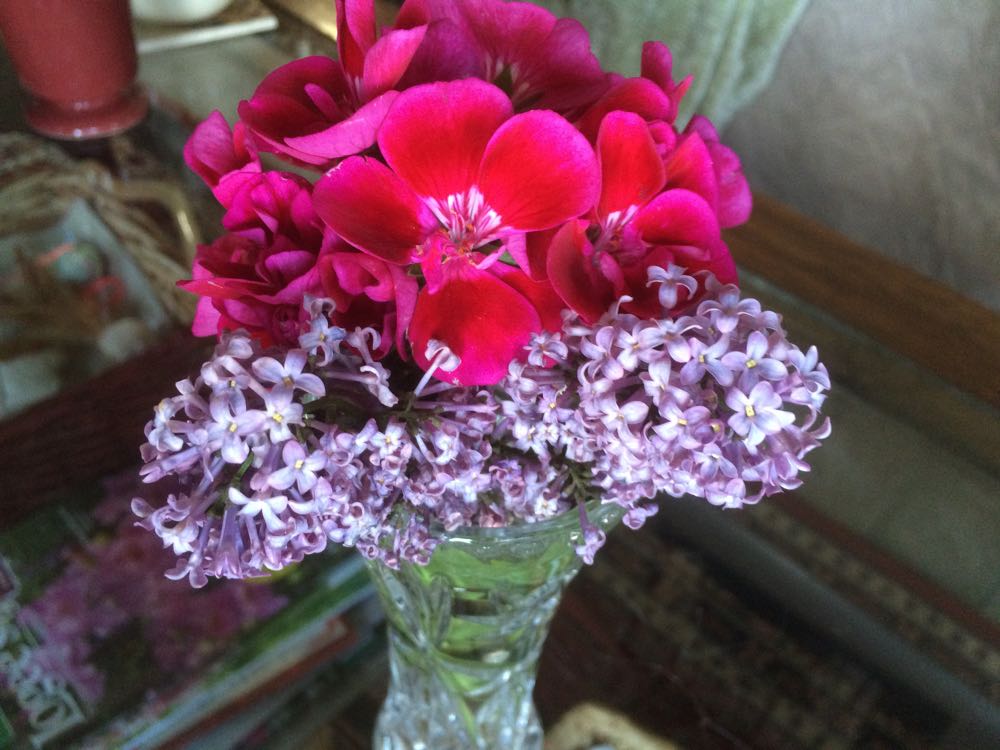
A sprig of old-fashioned lilacs keep a sprig of geraniums company on my den's coffee table.

A sprig of old-fashioned lilacs keep a sprig of geraniums company on my den's coffee table.

So pretty!

Charlotte
Spring Table Top Flowers

This will work for any of the four seasons but I happened to put this arrangement together in spring because I didn't want to mix daffodils with other spring flowers. Daffodils have a toxin that kills other flowers unless the toxin has been drained for a few hours.

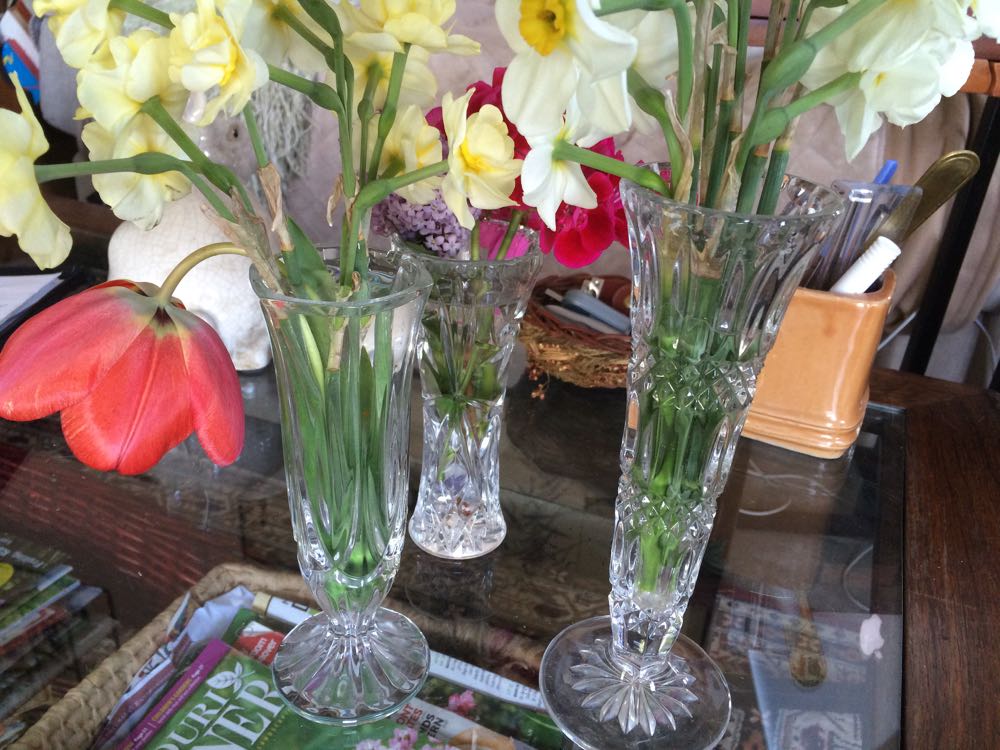
A collection of favorite flower vases at different heights makes a nice table top arrangement and keeps toxic daffodils from killing off other spring flowers.

My collection of cut glass flower vases helps flowers get along on my coffee table.

My collection of cut glass flower vases helps flowers get along on my coffee table.

You can also mix other flowers in the vases, just keep daffodils to themselves.

Keep daffodils separate from other flowers in vases so daffodils don't kill other flowers.

Keep daffodils separate from other flowers in vases so daffodils don't kill other flowers.

Any collection of flower bases will work, just keep them at different levels so you can see all of the flowers at one glance.

Charlotte
Busy Gardener

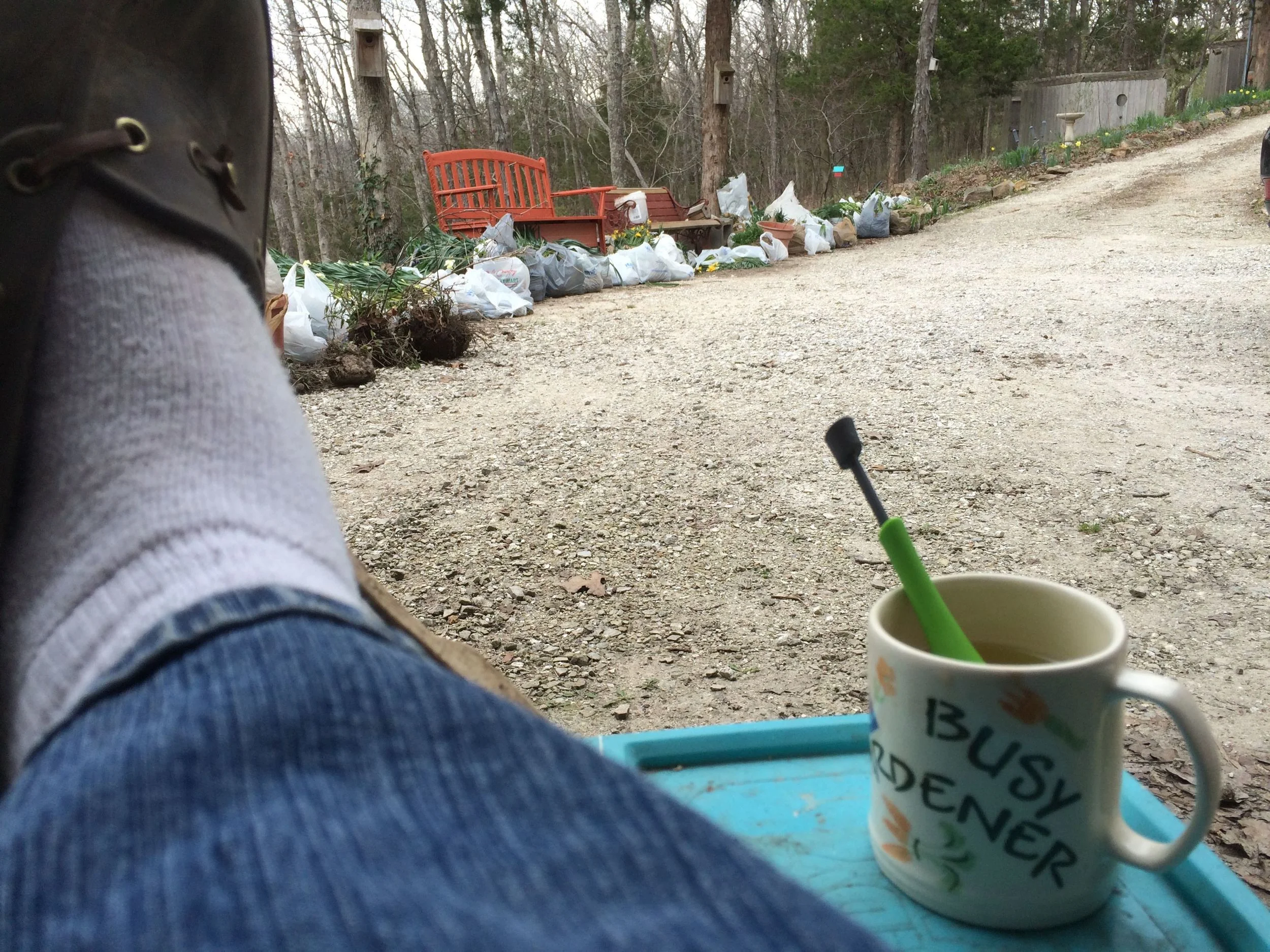
My beekeeping friend David hand-carried this lovely porcelain cup for me from a visit to England.

My beekeeping friend David hand-carried this lovely porcelain cup for me from a visit to England.

It's been an unexpectedly busy spring 2016. After retiring from my full time job December 31, 2015, I had this, now apparently quite silly idea that I would be living the leisurely life. 

One of my goals over my work years was to sleep in, something I have yet to do. Not that I am complaining, if the day is sunny and warm and I don't have some meeting to attend or deadline to meet, I am out in my garden. 

Well, first I am in a neighbor's garden. I have permission from the new property owner. Their plan is to bring in a bull dozer and turn over the soil so grass can be planted. In the meantime, I am digging up basically a 50-year plus garden, trying to save everything I can identify, and even some things I can't.

It would probably have worked better if they had just cleared up the property and left the basically flower garden intact with only paths to mow but then the site would have looked like my house. I like not having to mow, it leaves me more time to play with my bees and grow things I can eat. 

Half of the dug up plants are now at my house; the other half are at another nearby beekeeping friend's house. Knowing how much Tom likes to plant, I invited him to help me dig and split the plants with him. We don't worry too much about who has what plant because we know where each other lives. It's enough for now that we saved most of the plants.

Thanks goodness for the excuse to stop long enough to break-in my new teacup. Now the planting starts, again.

What to plant, what to plant....

Charlotte

The Glory of Gardening

One of my favorite spring flowers, bleeding heart, greets visitors next to my front door.

One of my favorite spring flowers, bleeding heart, greets visitors next to my front door.

"The glory of gardening: hands in the dirt, head in the sun, heart with nature. To nurture a garden is to feed not just the body, but the soul."

— Alfred Austin

I was thinking about how gardening has shaped my life over the years. I chose not to live in places where I couldn't have clean water, clean air and a place to garden. Not that pick-axing the side of a MIssouri limestone hill is easy but, after more than 30 years, we have a rhythm of sorts: I build a hole, add amended soil and add a plant. Then we both wait to see what happens.

Sometimes the plant adopts well, other times it can literally take years for the roots to have enough energy to see light.

Doesn't matter if the plant is native or not, it's all about giving the plant time to adapt to its growing conditions. How many times do we see people trying to survive in the wrong career, wrong relationship, wrong place?

I am blessed I have the right place, for me.

Charlotte
How to Add Daffodils to Spring Bouquets

I added blue anemone, purple lilacs and a tulip after daffodils sat in water for a couple of days.

I added blue anemone, purple lilacs and a tulip after daffodils sat in water for a couple of days.

It is so tempting to want to grab a handful of spring flowers and plop them into a flower vase to enjoy inside. You can do so but you need to let the daffodils sit in water for at least a day first to remove toxins that kill other flowers.

Once daffodils have been cleansed, you can easily add tulips and other spring flowers.

If you don't have time to let the daffodils remove the toxins, put only daffodils in the bouquet or the toxins will wilt the other flowers.

It doesn't take long to do and is well worth the extra effort.

Charlotte


Training Eastern Redbud Trees

A friend recently said she didn't like Eastern redbuds because they tend to not grow straight. I couldn't help but say it helps if you're not regularly mowing them over but she does have a point; these lovely native Missouri trees do have a tendency to bow.

Tie Eastern redbud Trees to Help Them Grow Straight

Over the years, I have easily reduced that tendency by tying the young Eastern redbuds to encourage them to grow straight. Nothing difficult, I use twine and make sure the temporary fix is easily seen by anyone who may walk by, especially me, so I don't end up tripping myself.

I tie young Eastern redbuds to nearby older trees to help them grow straight.

I tie young Eastern redbuds to nearby older trees to help them grow straight.

When I see the twine start to sag or break, it's time to check the tree to see if it can stand up on its own.

It can take 1-2 growing seasons to get the straight line you want but it is worth it to keep these lovely native Missouri trees in your landscape.

Eastern redbuds add a lovely canopy of pink to my Missouri spring garden.

Eastern redbuds add a lovely canopy of pink to my Missouri spring garden.

Not all trees should be ramrod straight, I like the flowing curves Eastern redbuds create throughout my hillside garden.

Since deer have discouraged me from planting tulips, I like having Eastern redbud trees to give my garden a splash of pastel spring pink!

Charlotte

The Pink in a Missouri Spring

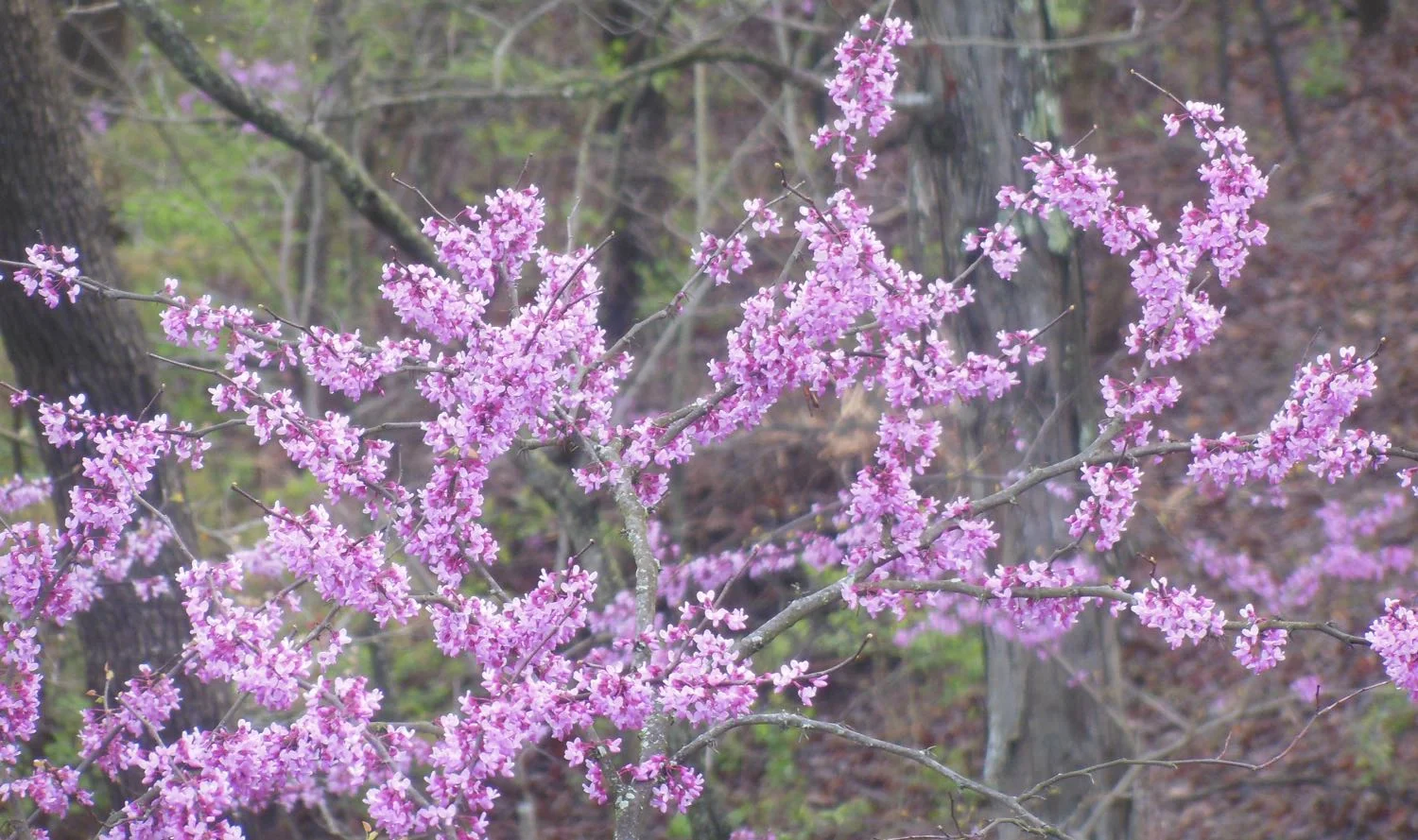
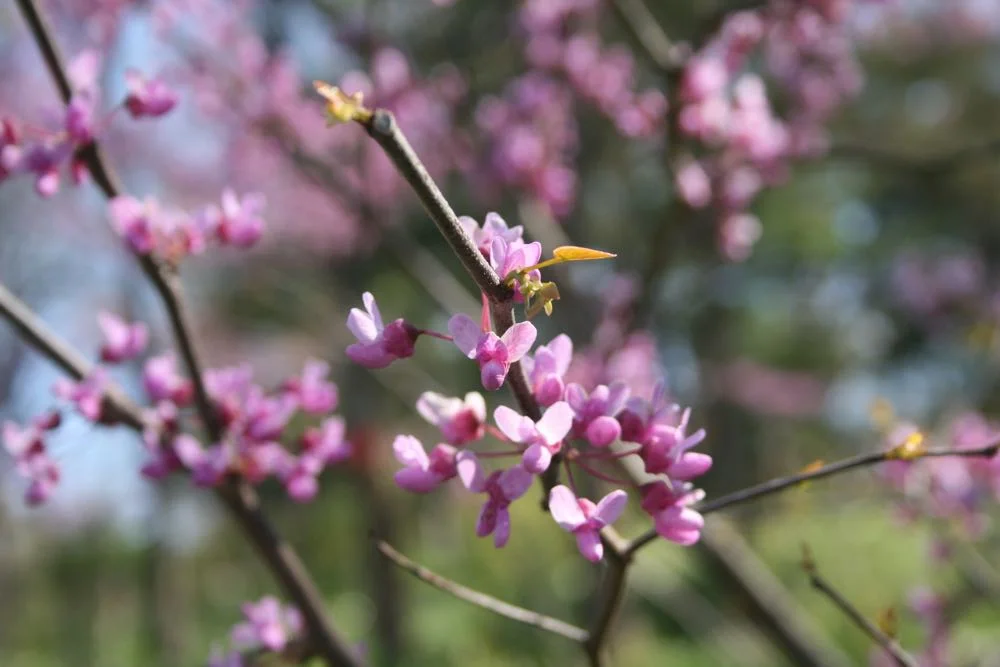
Redbuds in full bloom March 30, 2016 in bluebird gardens, my hillside Missouri garden and apiary.

Redbuds in full bloom March 30, 2016 in bluebird gardens, my hillside Missouri garden and apiary.

Missouri has a number of spring flowering trees and one of my favorites is the Eastern redbud. A smaller tree that blooms between native Serviceberry and elegant Dogwoods, redbuds welcome spring with a burst of pink and purples hues against grey stems.

One of my blooming redbuds early morning starting to show heart-shaped leaves.

One of my blooming redbuds early morning starting to show heart-shaped leaves.

Eastern Redbud Trees Have a Variety of Uses

Once blooms end, tiny heart-shaped leaves start to appear, covering the trees in green for the rest of the growing season and giving light shade to any garden. They are a good understory tree.

Birds like the tiny seeds; white-tailed deer like the leaves.

Eastern redbud is also a nectar source for my bees and a great salad garnish, the tiny pink flowers are edible.

The tiny flowers of Eastern redbud are edible and a nice pop of color in a salad.

The tiny flowers of Eastern redbud are edible and a nice pop of color in a salad.

Redbuds Have Been A Favorite Landscaping Tree

Some people go to great lengths to add redbuds to their landscape, Eastern redbud has been used an an attractive ornamental since 1641, according to Don Kurz, who wrote Shrubs and Woody Vines of Missouri.

I was lucky enough to have them as ample volunteers so all I had to do was trim them into shape. I focused on letting them surround my house and property, forming a pink canopy over my daffodils. I also tied a few to nearby trees to make sure they grew straight but in terms of work, these trees have been a lovely gift.

Charlotte

The Perfect Garden Gift

My new gardening cart has an adjustable handle and moves on its axel like a dump truck.

My new gardening cart has an adjustable handle and moves on its axel like a dump truck.

My original idea was to find a used little red wagon at a yard sale. I didn't want another wheel barrow. I have two I can barely keep upright when moving along the slope of my hillside garden.

Once I started digging up plants at a neighbor's garden, I knew I had to get serious about getting a cart. I would need the help to get the plants I was digging up to their new flower beds.

Enter my beekeeping friend David, who loves to shop. He was headed to Springfield, Mo. so would he mind looking around for a good garden cart. Two hours later, he texted me he had found the one in the photo with an adjustable handle and big tires. It barely fit in his car.

Once home, I was enchanted. It was easy to move and at the right height. 

"Did you see where it moves like a dump truck," David told me as he gave me the manual.

No, I said, but I can't wait to try it. Of all of the garden gifts I could have given myself, this was even better than I had planned.

Happiness, to a gardener, is definitely a new garden cart!

Charlotte

Dug Up Daffodils Still Bloom

One of the new daffodil additions to my spring garden dug up from another garden site.

One of the new daffodil additions to my spring garden dug up from another garden site.

Of all of my spring garden flowers, daffodils are definitely a favorite. And not by design. 

Over the years, I have been lucky enough to be given permission to dig up old gardens and bring those plants to my one acre hillside. I have a range of plants that grow in the different seasons but I surmise I have the most daffodil varieties.

I started with the small, old-fashioned bulbs that represent spring to me. They soon get over-shadowed by the larger, hybrid varieties but no fancy bulb can take away their special place as the harbingers of spring.

After some experience digging up daffodil bulbs, I started to bring home bulbs I couldn't identify until they bloomed. I kept the bulb clumps together - most of the time- so they could be replanted.

My latest daffodil haul without blooms has decided to surprise me. I picked one of the buds and placed it in water with my other cut daffodils. It is a variety I don't have, a long, orange nosed-daffodil with a white ruffle.

Can't wait to see what other colors and varieties of daffodils I may soon have blooming. Isn't spring grand?

Charlotte

Digging Up Daffodils

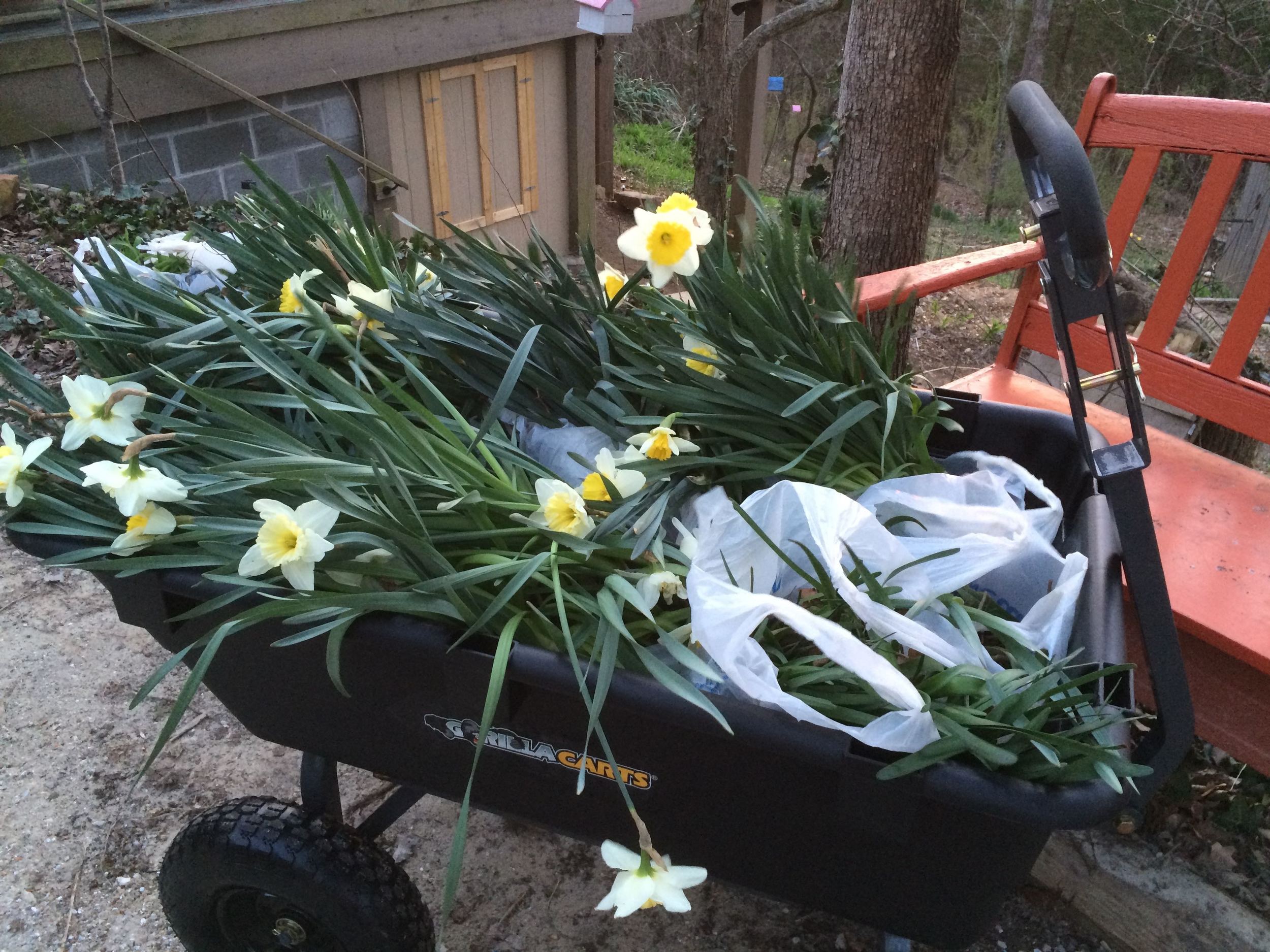
Some of the daffodils dug up from a neighbor's house. My friend Tom has the other half.

Some of the daffodils dug up from a neighbor's house. My friend Tom has the other half.

Gardening friends have told me over the years it's not possible to dig up daffodils to replant. I enthusiastically beg to differ. With the help of a number of pairs of good gardening gloves, I have done so several times in my gardening lifetime, leaving my one-acre hill side garden a spring "Daffodil-land" according to one of my neighbors.

Best Time to Dig Up Daffodils

Although I prefer to dig up daffodil bulbs after they have bloomed, I won't pass up a batch if they still have flowers. It helps to know what the bulbs are as I re-plant them.

How to Keep Bulb Varieties Together

When no flowers are in bloom, I wrap twine or a vine around the bundle of bulbs so at least I know that grouping is the same variety.

Bulb bundles with loose bulbs go into plastic bags so I can keep the whole grouping together. Nice way to recycle those bags, too.

Transplant Whole Soil Clump

If the soil is soft enough, I dig up the whole clump to separate later. Some of those bulbs still in a soil clump will continue to bloom once moved, especially if they are planted right before a slow spring rain.

It may take one season for the bulbs to settle before they bloom again but they are well worth the wait.

Charlotte

The Beginning of a Missouri Spring

Spring 2016 started with a 1" dusting of snow on Bluebird Gardens.

Spring 2016 started with a 1" dusting of snow on Bluebird Gardens.

There is a popular saying in Missouri. If you don't like the weather, wait, it is bound to change. The prediction was most appropriate the first day of spring 2016, which kicked off the new season with large snowflakes covering my one-acre hillside garden.

The snow was lovely blanketing my daffodils and flowering compact dwarf fruit trees. My compact dwarf apricot trees at the entrance to my herb garden were in full pink bloom, a startling contrast against the large white flakes.

I turned away from my windows long enough to make my breakfast of oatmeal and tea. By the time I settled back into my window seat, the snow was gone. For a second, I honestly thought I had dreamt it.

Charlotte


Fashionably Fending Off a Spring Freeze

My compact fruit trees covered with bags, blankets and towels against a hard freeze.

My compact fruit trees covered with bags, blankets and towels against a hard freeze.

The weather forecaster March 24, 2016 was emphatic. As we were enjoying the early warm, sun-blessed spring days of 2016, he predicted there was going to be a hard freeze. Flowering trees were bound to be damaged, he warned, unless "precautions were taken."

Most freeze-managing advice is for commercial farmers; run sprinklers all night to keep the frost at bay seems to be the most popular solution. As a home gardener on the side of a Missouri limestone hill, with fruit trees scattered throughout my one acre, spraying is not a viable option.

Instead, I started by digging out old empty corn sacks and tied them over my flowering compact dwarf fruit trees. When I ran out of those, I plundered my collection of lightweight beach towels and blankets.

A beach towel keeps a flowering fruit tree covered against a spring frost.

A beach towel keeps a flowering fruit tree covered against a spring frost.

Towels are tricky to use because they can be heavy when draped over small trees. I tried to match the towel cover over branches that could handle the weight in a wind.

When I ran out of towels, I went through my closet and pulled out my spring jackets.

I used some of my lightweight jackets to cover flowering fruit trees to protect them from frost.

I used some of my lightweight jackets to cover flowering fruit trees to protect them from frost.

Frost notwithstanding, I do think I have the best-dressed fruit trees in the neighborhood!

Charlotte

Welcome, Spring!

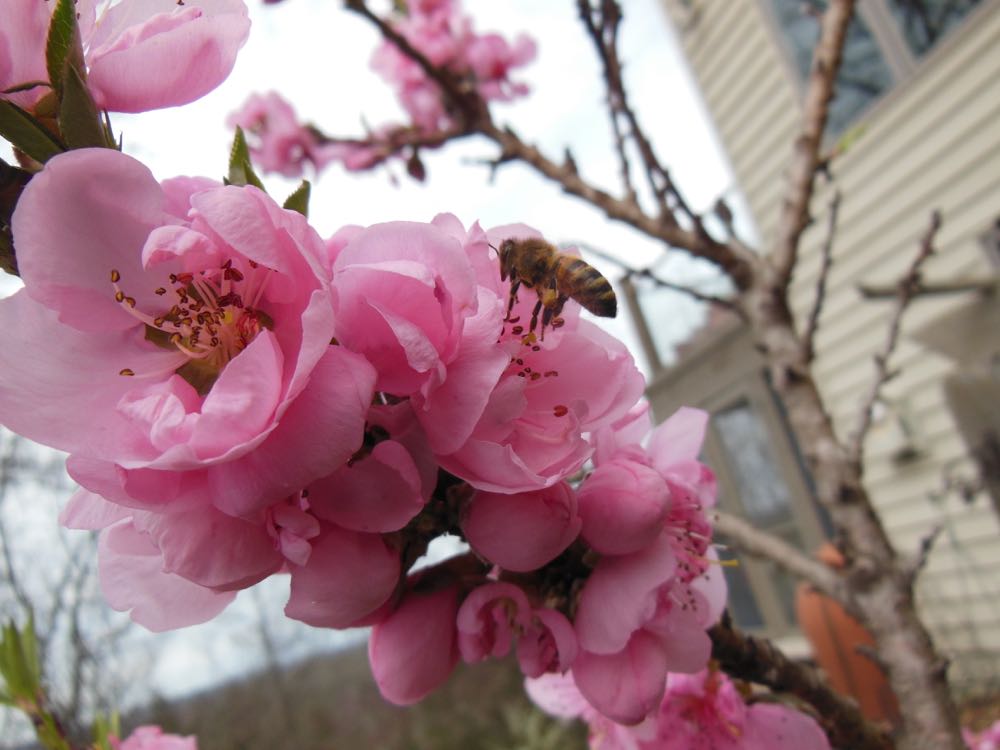
One of my honeybees visits a blooming dwarf apricot tree in bloom March 20, 2016.

One of my honeybees visits a blooming dwarf apricot tree in bloom March 20, 2016.

Welcome Spring!

"I love spring anywhere, but if I could choose I would always greet it in a garden." — Ruth Stout

There really is something about spring in a garden. No two days are the same, plants seemingly transforming themselves overnight unfolding promises of delicious treats. My compact dwarf fruit trees are adding a beautiful pink tone to my garden, a prelude to the redbud pink of native Missouri trees.

Can you tell I love spring?

Charlotte

First Lettuce

There are a number of ways people mark the arrival of spring. Purple crocus; yellow daffodils in bloom; maybe a favorite tree blooming. In my world, it's lettuce.

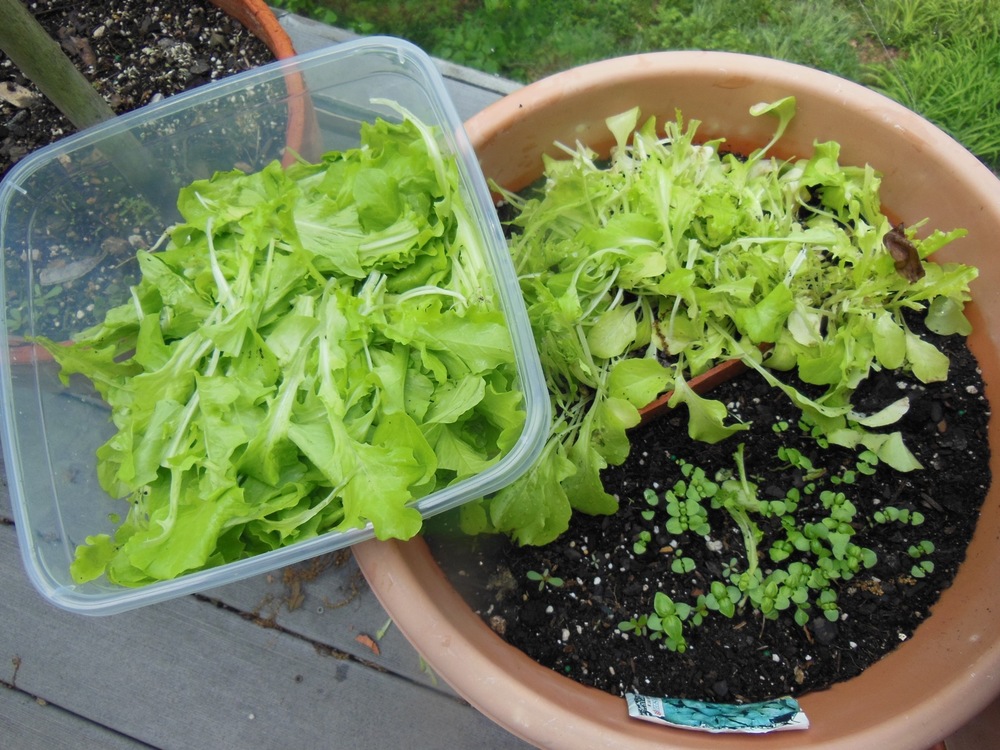
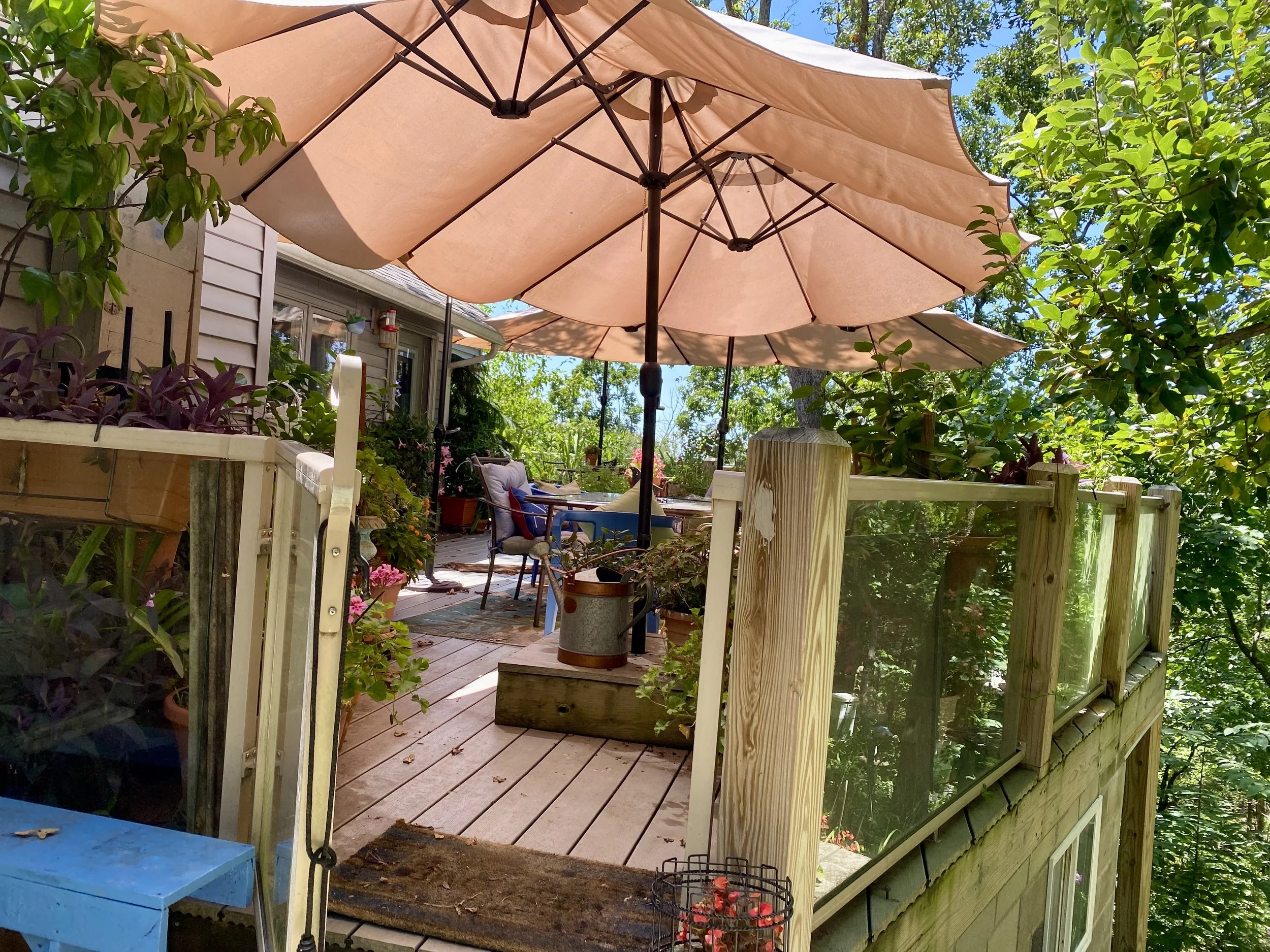
In addition to a dedicated vegetable garden spot, I keep a series of pots on my back deck where I can easily access herbs and greens. Sometimes the potted garden grows faster. It's on the equivalent of a second deck surrounded on three sides by glass. It also faces west so the soil warms up faster than the vegetable garden.

To get an early start on vegetables and herbs, I usually have a pot share lettuce seeds on one side and an herb on the other. I use shards from broken pots to set up growing guides. This year, lettuce is sharing space with sweet basil.

When I harvest my first greens for a salad marks the official beginning of spring for me.

It's a healthy, delicious and easy way to start!

Charlotte